

News Details
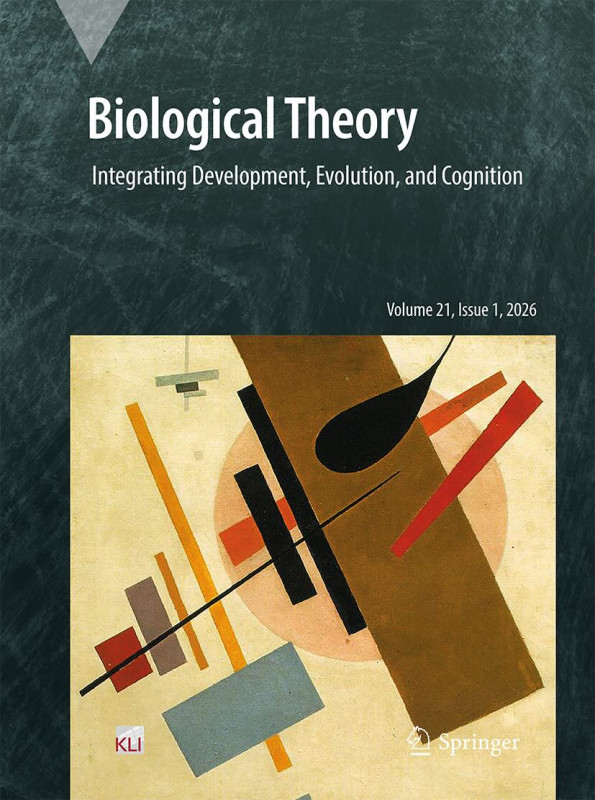
Biological Theory’s new issue, 21(1), opens with an editorial by the new Editor-in-Chief, Kevin Lala, stressing “The Importance of Biological Theory”.
Shiping Tang discusses the complexity of controlling biological pathways in unicellular and multicellular organisms, highlighting the evolution of regulatory mechanisms, the limited number of master hubs for pathway coordination, and the importance of a network-based approach to understanding pathway disruptions in diseases.
Igor Branchi examines how nature comprises interconnected living and nonliving systems across scales, with interfaces—distinct structures that enable functional interactions—serving as crucial control points and boundaries, offering insights into biological organization, brain-mind relationships, and potential applications across disciplines.
Jonathan Hill, David S. Oderberg, Christopher Austin, François Cinotti, Ingo Bojak, and Jonathan M. Gibbins provide a novel approach to goal-directedness in biological systems, emphasizing the roles of normative requirements and markers in initiating, executing, and evaluating actions, with implications for understanding mechanisms like mistake-proneness, mimicry, and adaptive behavior.
Xabier E. Barandiaran discusses the notion of malfunction and the normative character of functional attribution in biological explanation, proposing an alternative organizational theory of normative function and malfunction grounded on viability theory.
Justin P. Bruner asks when evolution leads to efficient outcomes in social dilemmas, such as the prisoner’s dilemma or stag hunt, and argues that increasing assortment in social dilemmas can sometimes lead to the stabilization of inefficient outcomes.
This issue also features a “Critical Concepts in Biological Theory” article by Sunil Nath, who rethinks the chemiosmotic theory proposed by Mitchel in the 1960s, as well as a review article by Nishtha Sah, Utkarsh Jain & Nidhi Chauhan highlighting different types of biosignatures that are known to be “potential biomarkers”, discussing their significance, and detection techniques.
Finally, William Andrew Rottschaefer provides a review of Martin Zwick’s Elements and Relations: Aspects of a Scientific Metaphysics.
The March issue also debuts the new cover for 2026, which features the Supremus No. 55 (1916, 80 x 80 cm, oil on canvas) by Kazimir Malevich (1879–1935).